> For the complete documentation index, see [llms.txt](https://docs.struct.com/llms.txt). Markdown versions of documentation pages are available by appending `.md` to page URLs; this page is available as [Markdown](https://docs.struct.com/changelog/february-2026.md).
# February 2026
February was all about refinement. From UI polish to core performance tweaks, we’ve spent the month sharpening the tools you use most to ensure your data stays organized and your team stays agile.
As the days get brighter, the PIM team has been busy illuminating your workflow. This month’s release is all about streamlining your experience and making your daily tasks more intuitive than ever.
### Bulk update workflow state
Tired of manually clicking through workflow states one by one? We’ve got you covered. You can now bulk update workflow states for multiple products at once, saving you time and streamlining your approval process.
{% columns %}
{% column valign="middle" %}
{% endcolumn %}
{% column %}
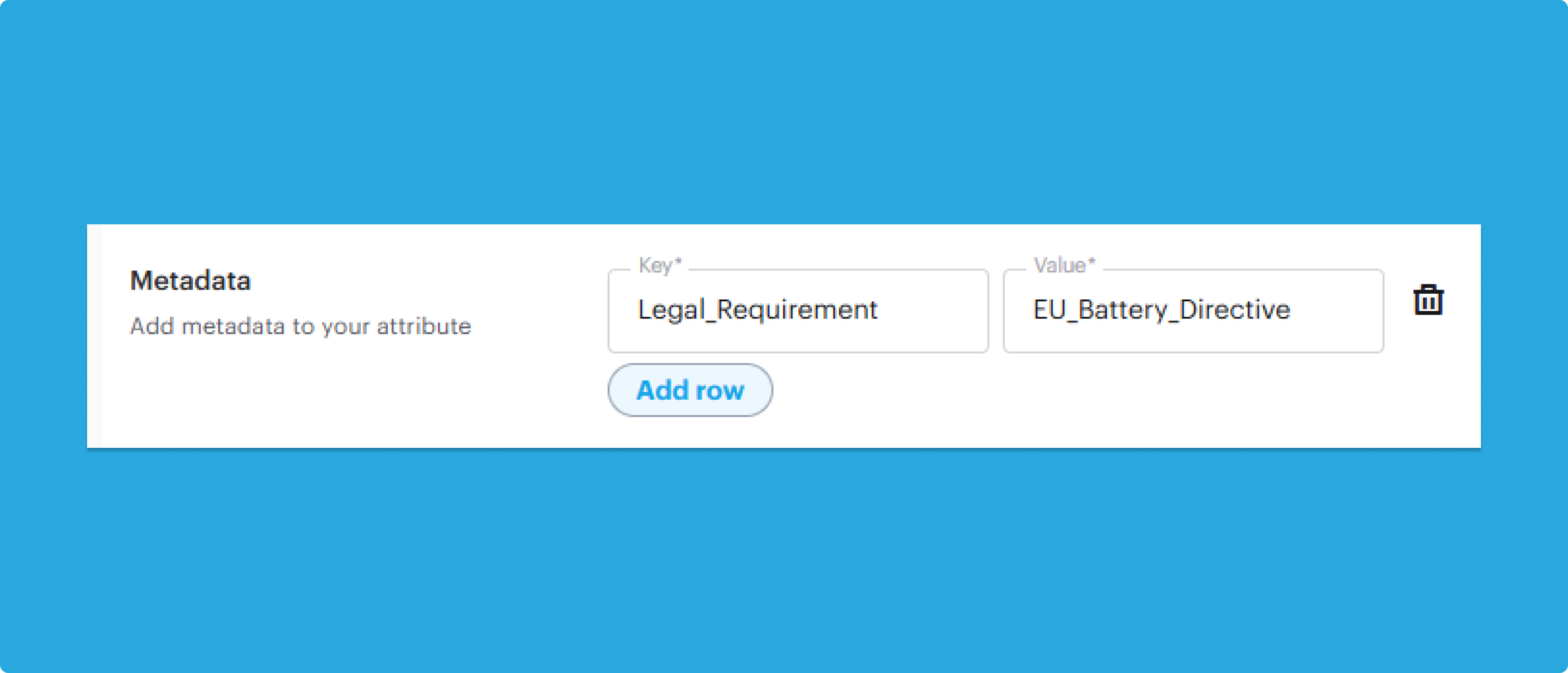
### Support for metadata on attributes
Introducing attribute metadata: A more granular way to manage your data model.
You can now define specific properties - such as ownership, priority, or display rules - directly on individual attributes. This allows you to store essential configuration data that belongs to the attribute itself, rather than treating it as a product-level sub-attribute.
{% endcolumn %}
{% endcolumns %}
{% columns %}
{% column width="41.66666666666667%" %}
### Add support for setting attributes available on products and variants in multiple catalogues
You can now inherit category attributes from any catalog, not just the Master Catalog. By selecting a specific catalog for your 'Category attributes section' in the Data Model, products can now inherit values from multiple categories across different catalogs simultaneously.
This gives you unparalleled flexibility in how you structure and reuse your data.
{% endcolumn %}
{% column width="58.33333333333333%" valign="middle" %}
{% endcolumn %}
{% endcolumns %}
### Other cool things we released this month
* It is now possible to bulk enable/disable business rules.
* Permissions are now sorted by permissions groups and alphabetically for easier access.
* Separated the permission to create, edit and delete workflows from the permission to transition between workflow states on entities. The permission ‘Manage Workflows’ now controls who can create, edit and delete workflows while the permission ‘Transition Workflows’ control who can transition workflow states on entities.
{% hint style="info" %}
**Fun Fact:** **How Many Holes Does a Donut Have?**\
\
It sounds simple. A donut has one hole. Obviously.\
\
But mathematicians (and certain curious colleagues) might disagree.\
\
In topology — the branch of math that studies shapes — a donut and a coffee mug are actually the same thing. Both have exactly one hole. Stretch one, bend the other, and mathematically they’re identical.\
\
Now things get stranger.\
\
If you punch a second hole in something, how many holes do you really have?\
Is a straw one hole… or two?\
If you flatten an object, does the hole disappear — or is it still there?\
\
Suddenly, something that felt obvious becomes surprisingly complex.\
\
The secret isn’t the hole. **It’s the definition.**\
\
When definitions shift, even simple things turn abstract fast.\
\
**Battle lesson from topology:** *simple things get complicated when definitions don’t match. Struct PIM keeps product data clearly defined and structured — so complexity doesn’t slow your teams down.*\
\
P.S. If all this hole philosophy feels a bit overwhelming, look up Madam Eris — a very cute dog with a very long nose. No topology debate needed there. Just objectively adorable. 🐶 :sparkles:
{% endhint %}
***
### Releases in February
* [February 25th](/changelog/february-2026/february-25th.md)
* [February 20th](/changelog/february-2026/february-20th.md)
* [February 19th](/changelog/february-2026/february-19th.md)
* [February 12th](/changelog/february-2026/february-12th.md)
* [February 9th](/changelog/february-2026/february-9th.md)
* [February 4th](/changelog/february-2026/february-4th.md)
* [February 2nd](/changelog/february-2026/february-2nd.md)
---
# Agent Instructions
This documentation is published with GitBook. GitBook is the documentation platform designed so that both humans and AI agents can read, navigate, and reason over technical content effectively. Learn more at gitbook.com.
## Querying This Documentation
If you need additional information that is not directly available in this page, you can query the documentation by asking a question.
Perform an HTTP GET request on the following URL with the `ask` and `goal` query parameters:
```
GET https://docs.struct.com/changelog/february-2026.md?ask=&goal=
```
`ask` is the immediate question: it should be specific, self-contained, and written in natural language.
`goal` is what the user is ultimately trying to achieve, the reason they need the answer. Sharing it helps GitBook give you a better, more relevant answer. A goal is most helpful when it describes the outcome the user wants rather than restating the question. For example, with `ask=how do I create an API token`, a goal like `automate deployments from our CI pipeline` lets GitBook tailor the answer to that use case.
The response will contain a direct answer to the question and relevant excerpts and sources from the documentation.
Use this mechanism when the answer is not explicitly present in the current page, you need clarification or additional context, or you want to retrieve related documentation sections.
.png?alt=media&token=ce700950-a9a7-4e2d-a1af-19ed20b5cc9a)
.png?alt=media&token=e764db03-b510-49a4-9a50-2d192f7a7f1c)